If you’re wondering whether a wedding videographer is worth it, there’s a good chance you’re actually asking two different questions.
Will we regret not having our wedding on film?
And:
Do we need to hire a professional videographer to get a wedding film we’ll love?
Those aren’t quite the same thing.
Video gives you something photography can’t: voices, movement, laughter, speeches, terrible dancing and all the little interactions happening around you. But there are different ways to capture those things.
A professional wedding videographer may absolutely be worth the money for you. For another couple, handing cameras to their guests and having the footage professionally edited afterwards might suit their wedding far better.
Here’s how we’d decide.
What are you actually paying a wedding videographer for?
A good wedding videographer isn’t simply somebody who owns a better camera than you do.
They film weddings for a living.
That means they’re constantly thinking about things most guests won’t consciously consider: composition, the rule of thirds, establishing shots, camera angles, lighting, sound and how one shot will eventually cut into another.
They’re anticipating moments before they happen and deliberately collecting the footage needed to construct a film.
There’s also the equipment. A professional may arrive with thousands of pounds’ worth of cameras, lenses, stabilisation and audio equipment. Knowing how to get the best from that kit takes training and experience.
So if your priority is a highly produced, cinematic wedding film with carefully composed footage, hiring a good videographer makes sense.
You’re paying for the person behind the camera as much as the camera itself.
But do you want a videographer at your wedding?
This gets discussed less often.
Hiring a wedding videographer doesn’t only affect what you receive after your wedding. It can affect your experience during it.
You may already have a photographer arranging group photographs, taking you away for couple portraits or asking you to stand somewhere because the light is particularly good.
Add a videographer and there’s another person who potentially needs shots from you.
Some couples actively like that. They want somebody taking charge of the visual side of the day and they’re perfectly happy to give a little of their time to get the results they want.
Other couples would rather have fewer people following them around.
Neither is right or wrong.
The question is whether you value the additional production enough to have another professional present throughout the day.
There’s another way to film a wedding
The choice doesn’t have to be:
Hire a wedding videographer or have no wedding film.
You can let the people who are already at the wedding film it.
That’s the idea behind ReelDay.
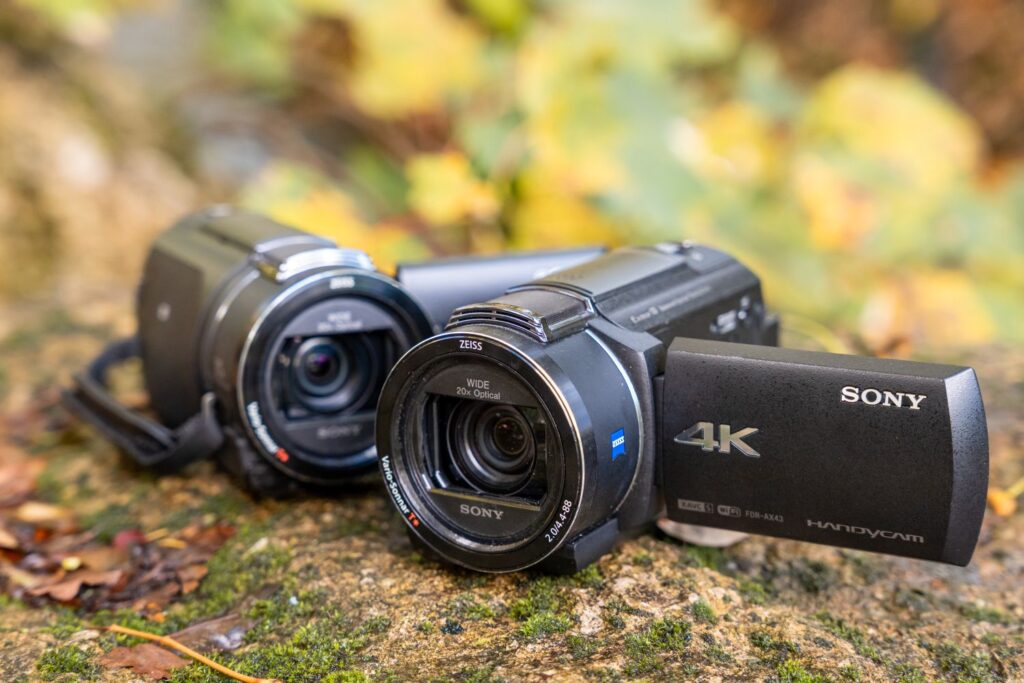
We send you simple 4K cameras for your wedding and your friends and family use them to capture the day. Afterwards, you send the cameras back to us and we professionally edit the footage into your wedding film.
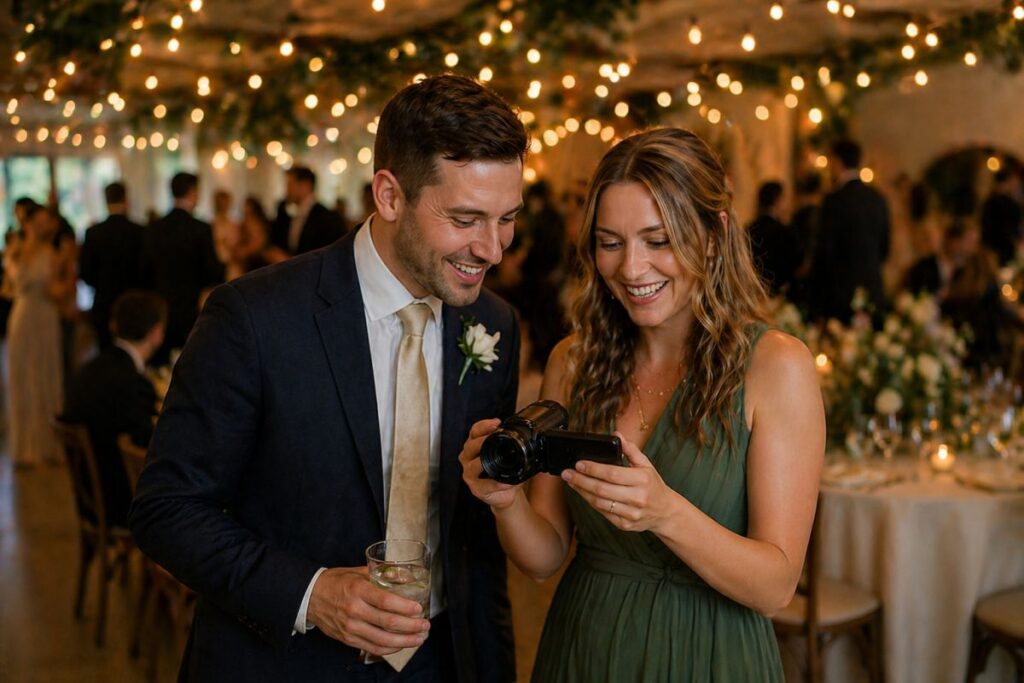
Your guests aren’t expected to become wedding videographers for the day. In fact, we don’t want them to.
They pick up a camera, film what’s happening, pass it around and enjoy themselves.
Your guests won’t film like professional videographers – and that’s partly the point
Give a guest a camera and they’re probably not thinking:
“I really need an establishing shot before we move into this sequence.”
They’re filming their mate dancing.
They’re capturing somebody laughing at the bar.
They’re recording the reaction to a speech, rather than only the person giving it.
They’re turning the camera on themselves and leaving you a message.
They’re filming because something funny, touching or ridiculous is happening in front of them.
Technically, a professional videographer is likely to produce more consistently composed footage. That’s their job.
But guest-filmed footage has a different quality to it: you’re seeing the wedding from inside the wedding.
And because people are so accustomed to filming with their phones, using a simple camcorder tends to feel very familiar. With our Sony camcorders, for example, you can pretty much open the screen, press record and start filming.
The cameras record in 4K, so the image quality is excellent. What changes is the person behind the camera and the way they use it.
People behave differently when their friend is holding the camera
This is perhaps the biggest difference between the two approaches.
Point a camera at someone and their behaviour can change immediately.
If the person behind it is a videographer they’ve never met before, a guest might become slightly more aware of themselves. They know they’re being filmed.
Now imagine it’s their brother, best friend or one of the bridesmaids pointing the camera at them.
It’s different.
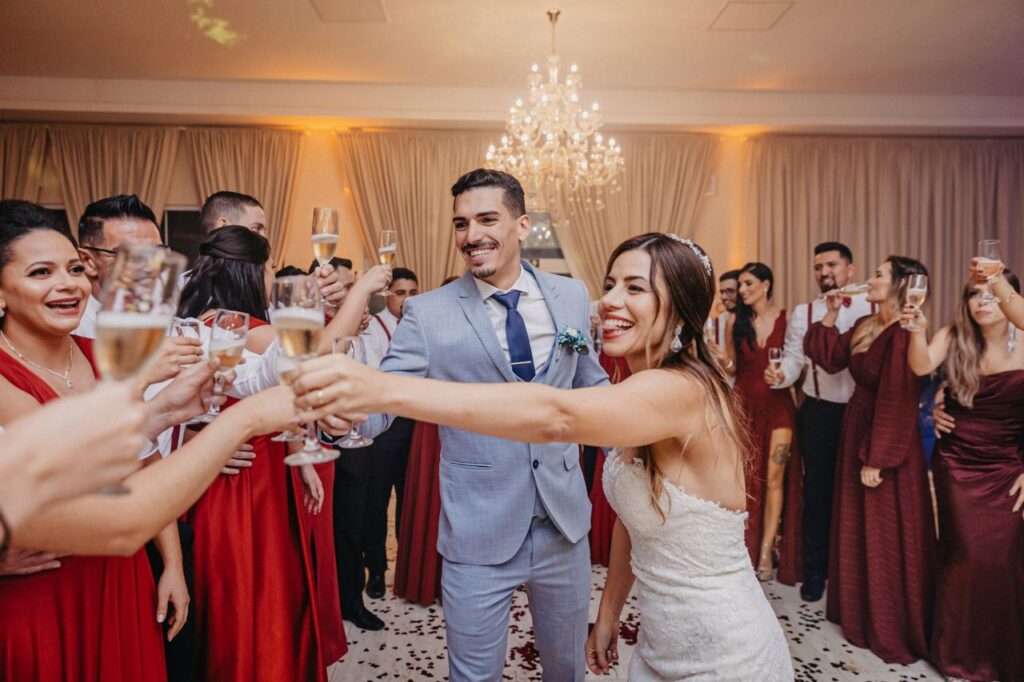
They’re talking to someone from their inner circle who happens to be holding a camcorder. They’re more likely to carry on behaving naturally.
That can result in wonderfully candid footage because the person filming isn’t an observer of the wedding. They’re part of it.
A professional videographer can of course be brilliant at putting people at ease and filming unobtrusively. But they can’t become somebody’s best mate for the day.
That relationship between the person filming and the person being filmed is something equipment alone can’t replicate.
Can amateur footage really become a polished wedding film?
Yes – but there’s an important distinction to make.
We’re not claiming that handing somebody a camera suddenly gives them the skills of a professional videographer.
It doesn’t.
The raw footage will naturally be more candid and less controlled. There may be beautiful compositions that happen almost accidentally alongside clips a professional would have framed differently.
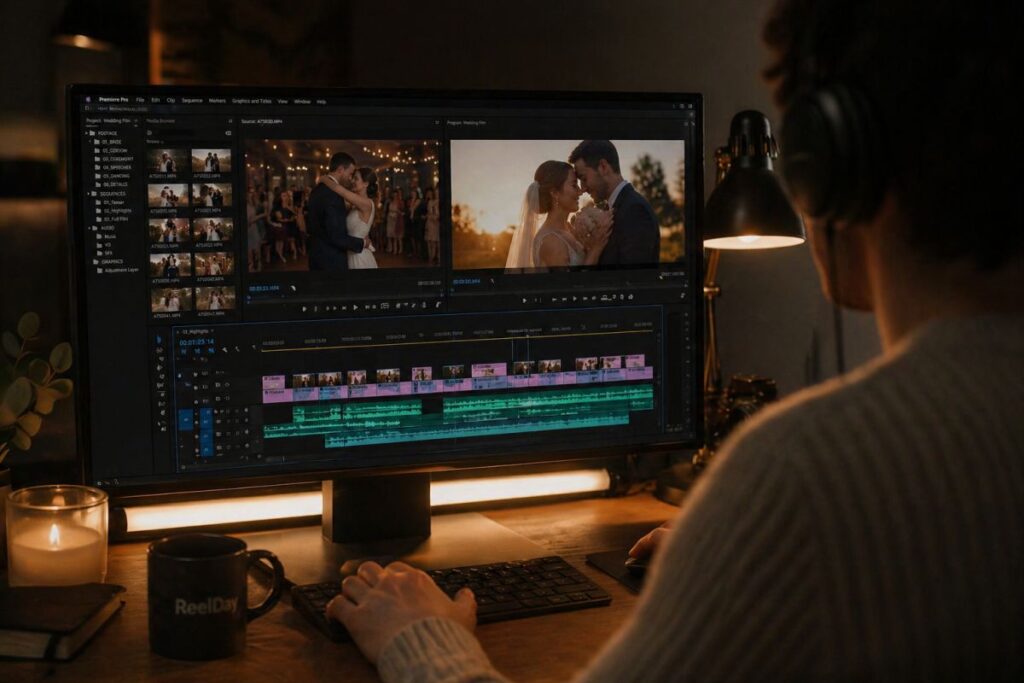
The editing is where we make sense of it all.
When the cameras come back, our job isn’t simply to put the clips in chronological order and stick some music underneath.
We go through the footage looking for the important bits: the sentimental moments, the funny ones, the touching exchanges, the things that make us laugh and the little interactions that help tell the story of your wedding.
We pull those moments out and shape them into a professionally edited film.
Your guests capture the ingredients. We make the film.
What can go wrong with guest-filmed wedding footage?
There is a trade-off, and it’s worth being straightforward about it.
Guests can miss things.
Someone can point the camera in completely the wrong direction. They can press stop when they think they’ve pressed record. A guest entrusted with capturing something can get distracted because, quite reasonably, they’re also trying to enjoy a wedding.
A professional videographer is there specifically to film. Your guests aren’t.
We reduce the risk by making everything as straightforward as possible. ReelDay cameras come with a simple instruction card, suggested shot list and guiding stickers, and we’re producing video guides covering both camera operation and getting useful shots.
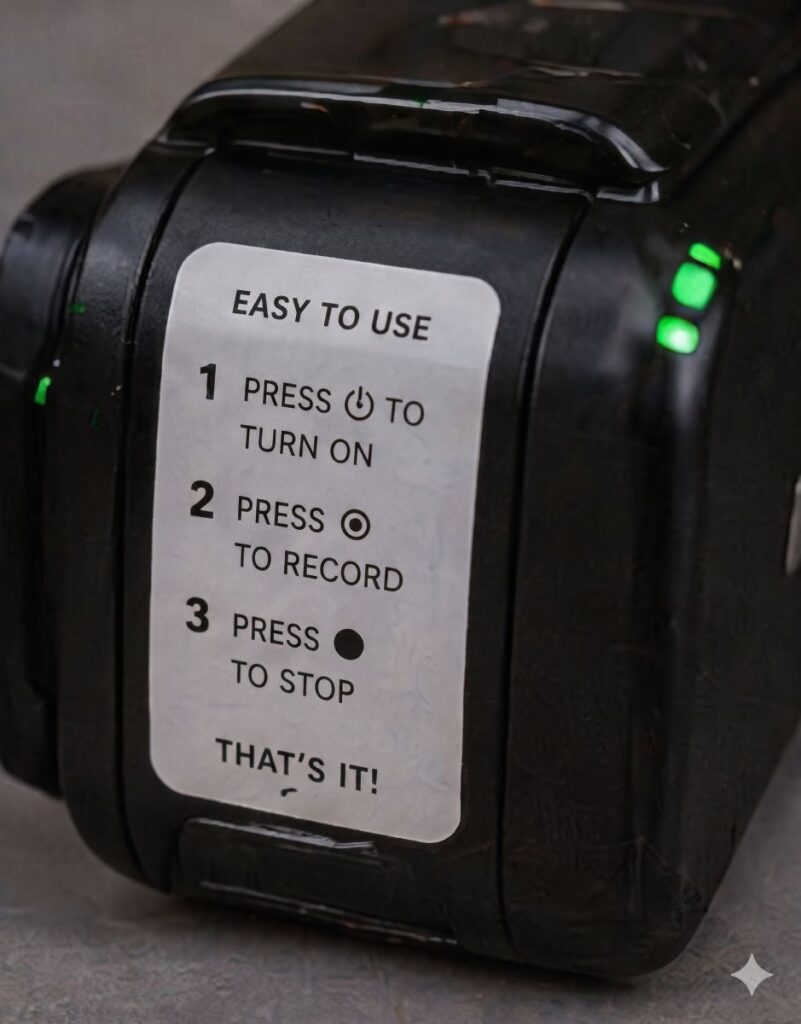
Couples who want extra reassurance can also hire tripods and wireless microphones, particularly where reliably capturing something such as a ceremony or speeches matters to them.
But there’s a balance here.
We don’t want your wedding to become a film production, and we don’t want Uncle Dave spending eight hours anxiously working his way through a 47-point shot list.
Give people some guidance, make the equipment easy to use and then let them have fun with it.
That’s usually where the best stuff comes from anyway.
How much does a wedding videographer cost?
This varies enormously depending on the videographer, location, length of coverage, number of camera operators and the finished films included.
Bridebook’s 2026 figures put average UK spending on wedding videography at around £1,514, with prices commonly falling somewhere between £500 and £2,500.
Higher-end cinematic productions can cost considerably more.
That doesn’t mean an expensive videographer is overpriced. You’re paying for their time on the day, their equipment, experience and all the work that happens afterwards.
The better question is whether those are the things you particularly value.
ReelDay starts from £595.
Our Sony UHD 4K Camcorder package includes:
- one Sony UHD 4K camcorder
- a 3–5 minute professionally edited, personalised wedding film
- all your organised raw footage delivered digitally
- three pre-charged batteries providing up to eight hours of filming
- a 256GB memory card
- suggested shot list, instructions and guiding stickers
- carry bag
- postage both ways
We also offer a two-camera DJI Osmo Pocket package from £599, including a 5-7 minute professionally edited wedding film.
The two pocket-sized cameras are particularly suited to couples who like the relaxed, guest-filmed approach but want smoother movement, stronger low-light performance and the ability to capture the wedding from two perspectives.
So, is a wedding videographer worth it?
If you have the budget and your heart is set on a very slick, cinematic film with deliberately composed footage, yes – we’d seriously consider hiring a professional wedding videographer.
It’s what they do for a living, and there’s a reason good wedding videography costs what it does.
You might also prefer a professional if you don’t want friends and family to have any responsibility whatsoever for capturing important parts of the day.
But if what you really want is to hear the speeches again, watch everyone dancing, see the moments you missed and have a professionally edited film that feels like your wedding, a traditional videographer isn’t your only option.
You might actually prefer having fewer suppliers following you around.
You might love seeing your wedding through your guests’ eyes.
And you might find that giving your friends a camera creates some of the funniest and most personal footage of the day.
So don’t start by asking whether wedding videographers are worth the money.
Start with a different question:
What do we want our wedding film – and the experience of making it – to feel like?
If the answer is highly controlled, cinematic and professionally filmed, hire a videographer.
If the answer is relaxed, candid and captured by the people who are already part of your day, that’s exactly why we created ReelDay.